


Blog
Full Grain Leather: The Complete Guide | Bovino Leather

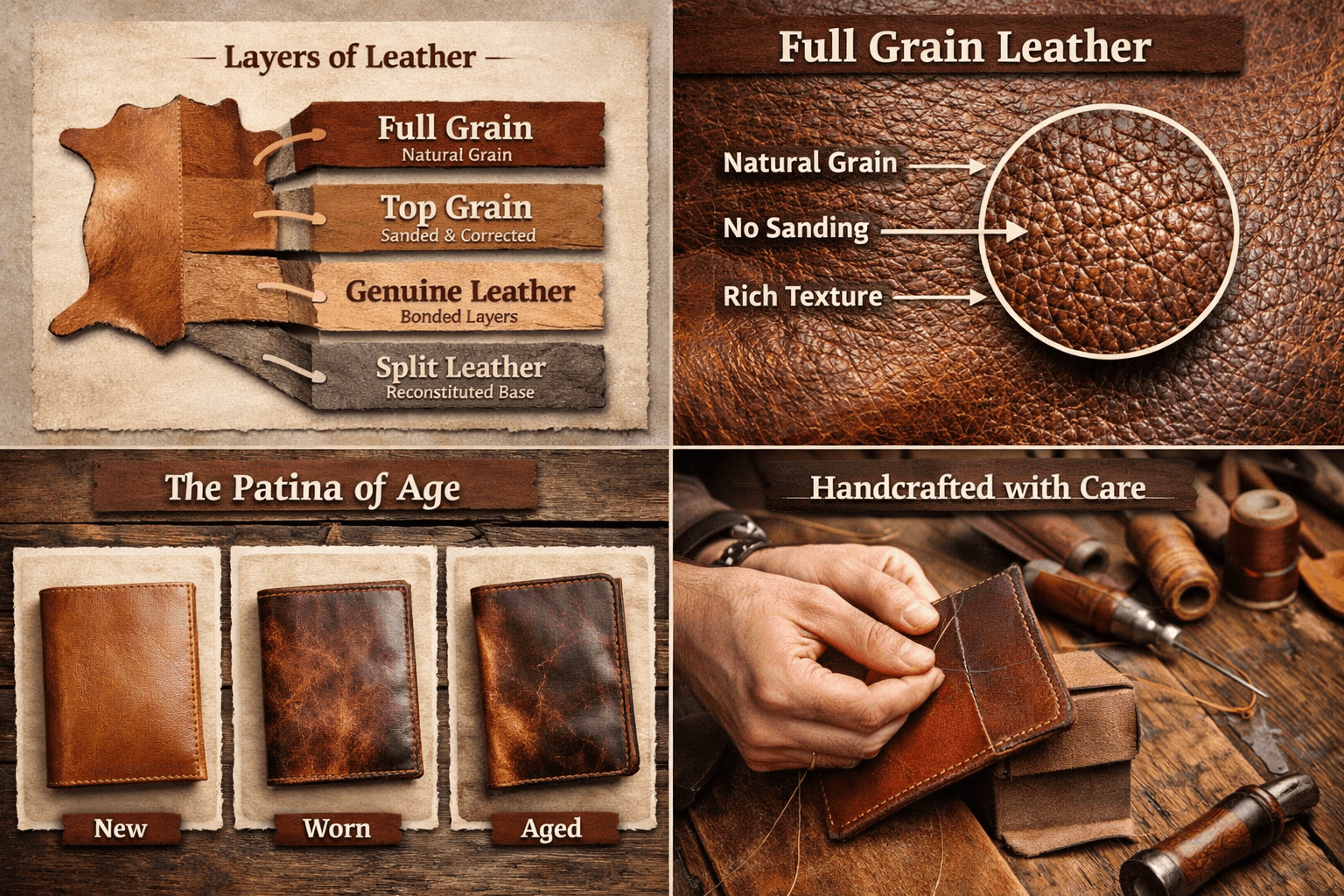
If you’ve spent any time shopping for a tool belt, work bag, or pair of suspenders, you’ve probably seen the term “full grain leather” stamped across half the listings on the internet. Some of those listings deserve it. Most don’t.
Full grain leather is the top layer of a hide — the part that still has its natural grain, its density, and its imperfections intact. It’s the strongest, most durable, and longest-lasting leather grade there is, and it’s the only leather Bovino Leather uses in its tool belt systems, suspenders, and pouches. But “full grain” gets thrown around so loosely in marketing copy that most buyers can’t tell the real thing from a good imitation.
This guide breaks down exactly what full grain leather is, how it’s made, how it compares to top grain, genuine, and bonded leather, and why it’s worth the extra cost for gear that has to survive a job site — not just look good in a photo.
What Is Full Grain Leather?
Full grain leather is the outermost layer of an animal hide, taken directly from the top of the split with nothing sanded, buffed, or corrected away. It includes the full thickness of the grain layer — the tightest, densest part of the hide, where the fibers are most tightly woven together.
That’s the technical definition. In practice, it means three things for anyone buying leather goods:
- The surface is untouched. Natural markings, pores, and slight variations in texture are still visible, because nothing has been sanded off to hide them.
- The fiber structure is intact. Because the tightest fibers in a hide sit closest to the surface, full grain leather keeps the strongest part of the material instead of removing it.
- It develops a patina. Full grain leather changes color and texture with age, oils, and use — a visual record of how the piece has been worn or worked.
This is different from leather that’s been “corrected” — sanded down and stamped with an artificial grain pattern to hide scars, brands, or insect bites in the hide. Corrected leather can still be called “genuine leather,” which is part of why the terminology confuses so many buyers. Full grain leather is graded specifically because the hide was clean enough, or good enough, to use without any of that correction.
For gear that has to hold weight, flex constantly, and take abuse — a full grain leather tool belt, a pouch full of tools, a set of suspenders under load all day — that intact fiber structure isn’t a cosmetic detail. It’s the difference between a belt that holds its shape for a decade and one that stretches, cracks, or tears within a season.
How Full Grain Leather Is Made
Understanding how full grain leather gets from a raw hide to a finished product explains why it costs more — and why that cost is justified.
1. Hide selection. Tanneries grade raw hides before anything else happens. Only hides with minimal scarring, even thickness, and clean surfaces are set aside for full grain use. A hide with heavy scarring or brand marks typically gets “corrected” instead — sanded and refinished — which immediately disqualifies it from being true full grain.
2. Splitting. Thick hides are split horizontally into layers. The top layer — the one that includes the original outer surface of the animal — becomes full grain leather. Lower layers (the “splits”) are used for suede, bonded leather, or other lower grades.
3. Tanning. The hide is tanned to stabilize the collagen fibers and prevent decomposition. Bovino uses oil-tanned full grain buffalo leather, a process that saturates the fibers with natural oils during tanning. Oil tanning produces leather that’s noticeably more flexible and water-resistant straight off the line than dry-tanned alternatives, which matters for gear worn and flexed constantly on a job site.
4. Dyeing and finishing. Full grain leather typically gets a light aniline or semi-aniline finish — enough to even out tone without masking the natural grain. Unlike corrected leather, nothing is sanded or stamped at this stage; the goal is to protect the surface, not disguise it.
5. Cutting and construction. The finished hide is cut into pattern pieces and assembled — stitched, riveted, and reinforced depending on the product. This is where craftsmanship matters as much as the material itself. A full grain hide badly stitched will still fail early; a well-built product starts with the right leather and is finished with construction to match.
That’s the whole process — no shortcuts, and no step where a lower-grade hide can quietly become “full grain” through finishing tricks. It’s a labor- and material-intensive process, and it’s the reason full grain leather goods cost more than synthetic or bonded alternatives.
Why Full Grain Leather Is the Highest Quality Leather
Leather is graded in a hierarchy, and full grain sits at the top for a specific, measurable reason: fiber density.
The outer layer of a hide — the grain layer — has the tightest fiber structure of any part of the skin. That density is what gives leather its strength, its resistance to tearing, and its ability to flex thousands of times without breaking down. Every layer below the grain layer has progressively looser, weaker fibers.
When a hide is corrected, sanded, or split to produce top grain, genuine, or bonded leather, some or all of that dense outer layer is removed. What’s left behind is still leather — it’s just structurally weaker.
This is why full grain leather is the standard material for goods that take real mechanical stress: work boots, saddlery, military gear, and heavy-duty full grain leather tool belts built to carry 20+ pounds of tools for a 10-hour shift. It’s not marketing language. It’s a function of where the material sits in the hide.
Full Grain vs Top Grain Leather
This is the comparison that trips up the most buyers, because top grain leather is also a legitimate, reasonably durable material — it’s just a different product with a different trade-off.
Top grain leather is full grain leather that’s had its outermost surface sanded down and refinished, usually to remove imperfections and create a more uniform, polished look. That sanding also removes the tightest part of the fiber structure — the same layer that gives full grain its strength.
| Full Grain | Top Grain | |
|---|---|---|
| Surface | Natural, unaltered | Sanded and refinished |
| Fiber density | Highest (uses the tightest layer) | Reduced (top layer removed) |
| Appearance | Shows natural grain, marks, variation | More uniform, often glossier |
| Durability | Superior long-term strength | Good, but wears faster under heavy stress |
| Patina | Develops rich, visible patina | Develops a patina, but less pronounced |
| Best for | Heavy-duty daily-use gear, tool belts, work bags | Fashion leather goods, upholstery, lighter-use items |
Top grain leather isn’t a bad material — it’s common in higher-end handbags and furniture because the sanded surface is easier to dye evenly and looks more consistent off the shelf. But for gear that’s going to be under constant mechanical load — a loaded tool pouch, a suspender system carrying 15+ pounds all day — that reduced fiber density becomes the limiting factor over time.
Full Grain vs Genuine Leather
Here’s where the labeling gets genuinely misleading. “Genuine leather” sounds like a mark of quality. It isn’t one.
“Genuine leather” is a labeling term, not a quality grade. It technically just means the material is made from real animal hide rather than a synthetic — but it says nothing about which layer of the hide was used or how it was processed. In practice, most products labeled “genuine leather” are made from the lower, weaker splits of a hide, heavily corrected, embossed with an artificial grain, and finished with a thick coating to hold everything together.
The result is a product that looks like leather, technically is leather, but shares almost none of the durability or aging characteristics of full grain material. It won’t develop a real patina — the coating on top usually just cracks or peels instead. And because it’s using the weaker layers of the hide, it won’t hold up to repeated flexing or heavy load the way full grain does.
If you see “genuine leather” on a product description, treat it as a floor, not a ceiling — it tells you the item isn’t fully synthetic, and that’s about all it tells you.
Full Grain vs Bonded Leather
Bonded leather is the bottom of the hierarchy, and it’s worth understanding clearly because it’s sometimes marketed with language that makes it sound premium.
Bonded leather is made from leftover leather scraps and fibers — shavings from other leather production — that are shredded, mixed with a bonding agent, and pressed onto a fabric or paper backing. It’s then coated with a polyurethane or vinyl layer embossed to look like leather grain.
It’s the least durable material in the leather family. It cracks, peels, and delaminates from its backing relatively quickly, especially under flexing, moisture, or heat. It has essentially nothing in common with full grain leather beyond containing some leather fiber content by weight.
Bonded leather has a place — low-cost book covers, budget furniture trim — but it has no place in gear meant to survive daily physical work. This is the comparison that matters most when a “leather” tool belt is priced suspiciously low: if it’s not full grain or top grain, it’s very likely bonded, and it will not hold up.
Why Full Grain Leather Lasts for Decades
Durability in leather comes down to two things: fiber density and how the material responds to flexing and load over time. Full grain leather wins on both counts.
Because the tightest fibers in the hide are concentrated near the surface, full grain leather resists tearing and abrasion far better than lower grades. Repeated flexing — the kind a tool belt goes through every time it’s put on, loaded, and worked in — breaks down weaker fiber structures over months. Full grain leather is built to take that same stress for years, often decades, with proper care.
This is also why full grain leather is one of the few materials that genuinely improves with age rather than degrading. As the surface is exposed to oils from use, sunlight, and handling, it darkens and softens in a way that increases its flexibility without compromising strength — the opposite of what happens to synthetic materials or coated leathers, which crack and stiffen as their surface coatings age.
For a piece of gear like a full grain leather tool belt system, that longevity isn’t an abstract selling point. It’s the difference between replacing a belt every year or two and owning one piece of gear for the length of a career.
Understanding Leather Patina
Patina is one of the most misunderstood aspects of leather ownership, and it’s worth explaining clearly because it’s often mistaken for wear damage.
Patina is the gradual darkening, softening, and surface change that full grain leather develops through exposure to oils, light, moisture, and handling. It’s a chemical and physical response — the leather’s natural oils and tannins react with UV light and the oils from your skin and daily use, deepening the color and adding subtle texture and sheen over time.
A few things are true about patina that are worth knowing before you buy:
- It’s unique to genuine, unfinished or lightly finished full grain leather. Heavily coated leathers (top grain with thick finishes, genuine leather, bonded leather) don’t patina the same way — their surface coating blocks that natural reaction.
- It’s not damage. Scuffs, color variation, and darkening on full grain leather are evidence the material is doing exactly what it’s supposed to do.
- It reflects use. A tool belt that’s carried a hammer holster on the same hip for two years will show it — and that’s part of the appeal for tradesmen who want gear that looks like it’s been worked, not gear that looks brand new indefinitely.
- It’s one-directional. You can slow or accelerate patina development with conditioning, but you can’t really reverse it, and most owners don’t want to.
If you’re buying a piece of full grain leather gear expecting it to look factory-fresh for its entire life, you’re buying the wrong material. The appeal of full grain leather is precisely that it ages into something more personal, not less useful.
How to Identify Authentic Full Grain Leather
Because “full grain” is used loosely in marketing, it helps to know what to actually look for.
- Check the surface for natural variation. Full grain leather will show subtle texture differences, small marks, or grain irregularities. If a “full grain” product has a perfectly uniform, glossy, repeating pattern, it’s likely been corrected or embossed.
- Look at the edges. On full grain leather, cut edges typically show a dense, fibrous cross-section rather than a layered or fabric-backed one. Bonded leather edges often reveal a visible backing material.
- Press and flex it. Full grain leather has a firm, substantial hand-feel and resists creasing sharply. Bonded and heavily coated leathers tend to feel more plasticky and crease in unnatural, permanent lines.
- Ask about the tannery and hide sourcing. A brand confident in its material will tell you specifically what kind of leather it uses — the animal, the tanning method, and the grade — rather than using “genuine” or “premium” as a stand-in for specifics.
- Smell it. This sounds unscientific, but it’s reliable — full grain leather, especially oil-tanned, has a distinct, rich leather smell. Heavily coated or bonded leather often smells more like plastic or chemical adhesive.
Bovino is specific about this on purpose: every product is built from oil-tanned full grain buffalo leather, not a generic “leather” or “genuine leather” label. That specificity is the kind of detail worth checking for on any product you’re evaluating, from any brand.
Caring for Full Grain Leather
Full grain leather is durable, but it isn’t maintenance-free. A little regular care goes a long way toward extending its already long lifespan.
- Clean gently. Wipe off dirt and dust with a dry or slightly damp cloth. Avoid harsh soaps or all-purpose cleaners, which can strip natural oils.
- Condition periodically. A quality leather conditioner replenishes oils lost to sun and use, keeping the material flexible and preventing dryness or cracking. How often depends on use and climate — heavily worked gear in dry conditions needs it more often.
- Avoid prolonged water exposure. Oil-tanned full grain leather has natural water resistance, but it isn’t waterproof. Wipe off moisture promptly and let it air dry away from direct heat, which can cause stiffening or warping.
- Store it properly. Keep leather gear away from direct sunlight for extended periods and in a place with reasonable humidity — not a hot attic or a damp basement.
- Let the patina happen. Resist the urge to over-clean or over-condition in an attempt to keep leather looking “new.” Some darkening and character are the material doing what full grain leather is supposed to do.
With this level of care, a full grain leather tool belt or bag isn’t a one- or two-year purchase — it’s realistic to expect a decade or more of daily use, which is a major part of the value calculation covered next.
Is Full Grain Leather Worth the Price?
Full grain leather goods cost more upfront than synthetic, genuine, or bonded alternatives. Whether that’s worth it depends on how you’re using the gear and what you’re comparing it against — so it’s worth breaking down honestly rather than just insisting the answer is always yes.
The case for full grain leather:
- It typically outlasts multiple replacements of lower-grade materials, which can make the effective cost-per-year lower even at a higher purchase price.
- It holds up to daily mechanical stress — flexing, load-bearing, abrasion — better than any other leather grade, which matters directly for tool belts, pouches, and suspenders carrying real weight.
- It ages into a more comfortable, broken-in feel rather than degrading, and the patina it develops is genuinely part of the appeal for a lot of buyers.
- It’s a more honest material — what you see is what you get, without corrected surfaces or synthetic coatings masking the underlying quality.
Where it’s a genuine trade-off:
- If the gear is for occasional or light use, the extra durability of full grain leather may go largely unused, and a top grain or synthetic alternative could be a reasonable choice.
- Full grain leather is heavier than synthetic materials, which matters for buyers prioritizing minimum weight over maximum durability.
- The upfront cost is real, and for a first-time buyer without the budget for it, a well-made top grain product is still a legitimate, functional choice — just not with the same long-term ceiling.
For daily professional use — a tradesman putting on a tool belt every workday, loading it with hammers, drivers, and fasteners, flexing it constantly for hours at a time — full grain leather earns its price through the number of replacement purchases it prevents. That’s the specific use case it was built for, and it’s the honest reason Bovino builds around it rather than a cheaper alternative.
Why Bovino Uses Full Grain Leather
Bovino Leather builds tool belt systems, suspenders, individual tool bags, and accessories for tradespeople — framers, carpenters, electricians, and other professionals who put their gear through real, daily mechanical stress. That use case is exactly what full grain leather was made for.
Every Bovino product starts with oil-tanned full grain buffalo leather, chosen specifically because buffalo hide offers a dense, thick fiber structure suited to heavy-duty gear, and oil tanning gives it flexibility and natural water resistance from the start — useful for leather that’s worked outdoors, on job sites, in variable weather.
That material choice runs through the whole product line:
- The full grain leather tool belt systems are built to carry a full day’s worth of tools without the leather stretching out of shape or the stitching giving way under load.
- The leather suspenders distribute that weight across the shoulders using the same full grain construction, so the load-bearing points don’t wear out first.
- The individual leather tool bags and leather accessories — pouches, hammer holders, and add-ons — are cut from the same material standard, so a buyer building out a full rig isn’t mixing quality tiers across pieces.
This isn’t a cosmetic decision. It’s a practical one: professionals who rely on their gear every day need it to survive daily abuse without becoming a recurring cost. Full grain leather is the material that makes that possible, and it’s the reason Bovino doesn’t build with anything less — including on entry-level pieces, where it would be easiest to cut the material to hit a lower price point.
Frequently Asked Questions
What is full grain leather? Full grain leather is the outermost, unaltered layer of an animal hide — the layer with the densest fiber structure and the natural, un-sanded grain still intact. It’s the strongest and most durable leather grade available.
Is full grain leather the same as genuine leather? No. “Genuine leather” is a labeling term that only means the product is made from real hide, not the layer or quality of that hide. Most genuine leather products use lower, weaker layers of the hide that have been corrected and embossed, while full grain leather uses the intact top layer.
How can I tell if leather is really full grain? Look for natural surface variation rather than a perfectly uniform pattern, check that the material has a firm, dense hand-feel rather than a plasticky one, and look at how the brand describes its sourcing — specific tanning and hide details are a good sign; vague terms like “premium leather” without specifics are not.
Does full grain leather scratch easily? It can show surface marks from use, but these typically blend into the material’s natural patina over time rather than looking like damage. This is different from top grain or coated leathers, where scratches can crack a surface finish.
How long does full grain leather last? With reasonable care — cleaning, occasional conditioning, and avoiding prolonged water exposure — full grain leather goods commonly last a decade or longer, even under daily heavy use like a tool belt worn on job sites.
Is full grain leather waterproof? Not fully. Oil-tanned full grain leather has natural water resistance and handles occasional moisture well, but it isn’t waterproof, and prolonged soaking should be avoided and followed by proper air drying.
Why is full grain leather more expensive? It requires higher-grade hides with minimal natural flaws, a more involved tanning and finishing process, and it can’t be “corrected” the way lower grades can to disguise imperfections in lower-quality material. The material and process cost more, and the finished product lasts significantly longer as a result.
What’s the difference between full grain and top grain leather? Top grain leather is full grain leather that’s had its outer surface sanded and refinished, which improves visual uniformity but removes some of the densest, strongest fiber layer. Full grain keeps that layer intact, giving it superior long-term durability.
Final Thoughts
Full grain leather isn’t a marketing term — it’s a specific, verifiable grade of material defined by which layer of the hide it comes from and how much of that layer’s natural fiber structure remains intact. That structure is what makes it the strongest, longest-lasting leather available, and why it’s the standard for gear that has to survive real daily use rather than sit on a shelf.
For tradespeople choosing a tool belt, suspenders, or a pouch that has to carry real weight for years, understanding this distinction is the difference between a purchase that lasts a season and one that lasts a career. That’s the standard Bovino builds to — oil-tanned full grain buffalo leather in every belt system, suspender, tool bag, and accessory it makes, with nothing corrected or substituted to hit a lower price.
